
Toombs Projected and Actual Dates
A projected date estimates a future custody endpoint. An actual date records an event that has occurred. In GDC records, “MAX POSSIBLE RELEASE DATE” is the outer state-prison date produced by sentence computation. “ACTUAL RELEASE DATE” documents a completed release when it displays a date rather than “currently serving.” “CURRENT STATUS” helps show whether the record is active or inactive.
The Toombs current-inmate roster does not publish a projected county-jail date. A person awaiting trial may leave after bond, first appearance, or a court order, or may remain due to a hold. Someone serving a local sentence may require a jail time-served calculation. Court and jail staff control those records, not the statewide offender search.
- Time served
- Credit for qualifying time already spent in custody.
- Detainer
- A request from another authority to hold or receive the person.
- TPM
- A tentative parole month used by the Board for final review planning.
- Discharge
- The official end of a custody or supervision term.
Find a Toombs Projected Release Date
Identify the custody system first. The Toombs current roster answers whether the person is listed in county custody on a selected date. The GDC Find an Offender tool covers people who entered Georgia state-prison custody. The Board's TPM source covers parole planning for eligible state prisoners.
- Confirm the person's full name, birth year, case number, or GDC ID.
- Check the county roster if the arrest or sentence remains local. Do not expect a future date field there.
- For a GDC prisoner, search by name, GDC ID, case number, or descriptive details and open the matching record.
- Read maximum possible release date, actual release date, current status, sentence history, and most recent institution together.
- Check the TPM explanation and lookup only when parole consideration applies.
- Confirm local calculations with the jail or court, and state calculations through GDC records when written proof is needed.
GDC warns that online information should be verified through written correspondence with Inmate Records and Information at PO Box 1529, Forsyth, GA 31029 before factual assumptions are made. The broader Toombs County release search explains how county, state, federal, and immigration systems divide custody.
Georgia Credits for Toombs Sentences
Georgia Code section 42-5-101 authorizes work incentive credits for eligible felony prison terms in GDC custody other than life. The Performance Incentive Credit program, or PIC, recognizes progress in programs, work assignments, and good behavior. Credits are reported to the Parole Board and may affect final parole decisions.
The statute permits up to one day of qualifying work incentive credit for each day of approved participation, but that does not create a universal one-for-one release promise. Eligibility can change. The Board can reconsider based on new information, and some offense or sentence classes are excluded or restricted.
Georgia should not be summarized as “every inmate serves 85 percent.” Serious violent felonies, repeat-offender provisions, life terms, older earned-time categories, straight-time rules, and Board discretion differ. The Board's eligibility guidelines use crime severity and assessed risk to produce a recommendation, but the Board may accept or reject it.
Why Toombs Release Dates Change
A date can move because the underlying legal or custody facts change. County and state systems respond to different events. A posted bond can speed a county exit, while a new hold can stop it. State sentence credit or a Board action can affect a GDC timeline.
| Factor | Possible effect | Source to check |
|---|---|---|
| Bond or court order | Creates, changes, or revokes a county release path | Toombs court and bond paperwork |
| Sentence or jail credit | Changes the computed custody end | Court, jail, or GDC |
| Detainer or hold | Delays community release or causes transfer | Holding and receiving agencies |
| Transfer | Ends one agency's custody but begins another's | County record and destination agency |
| PIC eligibility | May affect parole consideration or length of stay | GDC and Parole Board |
| TPM or Board action | May advance, postpone, cancel, or withdraw a parole plan | State Board records |
| Misconduct | Can postpone or cancel a planned parole event | GDC and Board |
Residence-plan verification can also affect parole timing. The Board may withdraw a grant before its effective date. A stale screenshot or copied date cannot show those later decisions, so a fresh agency check matters.
Confirm Toombs County Release Dates
For a local release, compare the live roster, VINE status, bond or court paperwork, and the Sheriff's release record. A name that vanishes from a current roster is not enough. It may reflect release, transfer, a search mismatch, or a data update.
Register through the VINE Inmate Check when notice of a county release or transfer is needed. VINE can report a custody change, but the originating record supplies formal proof and the legal basis. For a GDC release, read actual release date and current status together, then follow the GDC verification instruction.
Federal dates belong to BOP. Immigration detention belongs to ICE within its locator scope. A Toombs County case does not make every later custody event a county release.
Toombs Parole Month Is Tentative
The State Board calls its planning field a Tentative Parole Month. A TPM is the month when final review is expected and a parole release date may be set if the Board finds release appropriate. It is not the same as GDC's maximum possible release date and is not a final parole grant.
Good conduct and program completion can support the plan. Misconduct can postpone or cancel it. Rehabilitative progress can lead the Board to advance a TPM, and the Board may withdraw a parole grant before the effective date. Outcomes can also include denial or conditional transfer to a detainer.
General parole-consideration timing appears in Georgia Code section 42-9-45. It generally uses six months or one-third for misdemeanors and nine months or one-third for felonies, whichever is greater, subject to serious-offense, recidivist, life-sentence, and other exceptions. Eligibility is only the point at which consideration may occur.
Toombs Jail Dates Follow Court Action
For county detention, no public formula supplies an exact exit time. Release may depend on bond posting, first appearance, a court order, time served, sentence completion, hold resolution, medical or court transport, or transfer. The Sheriff's local release information says later court dates are mailed and that bond or citation papers control which court path applies.
Felony matters, misdemeanor bond cases, city citations, and Georgia State Patrol tickets can route to different courts or paperwork. An address change should be reported to the Clerk so a mailed notice is not missed. That court step continues after jail release and should not be confused with the custody date itself.
The Toombs roster's lack of a future date is therefore a real local limitation, not a missing calculation that can be safely estimated. Ask the jail or court that controls the case. Do not calculate a date from the arrest date alone.
Read Toombs GDC Date Fields
The official GDC offender-information page introduces the statewide search and its custody records.
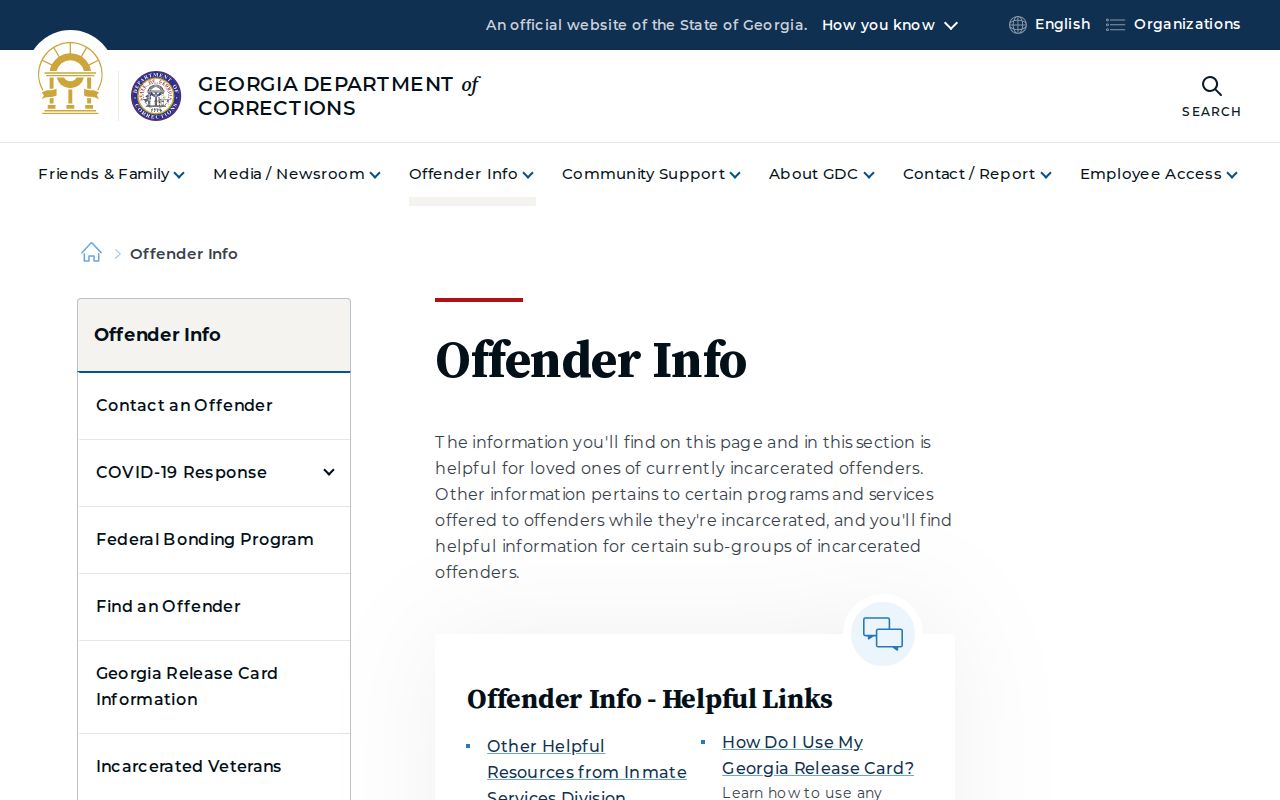
The captured source identifies the state channel that should be used for a Toombs County defendant who entered GDC custody. Match the person before reading date fields, and verify the online result as GDC instructs.
Compare Toombs GDC Sentence Fields
A GDC detail record can include current and prior sentences, incarceration begin and end dates, major offense, conviction county, most recent institution, maximum possible release date, actual release date, and current status. No single field tells the full story. A maximum date without the sentence history can be misunderstood, while an actual date without status can hide a later return to custody.
| GDC field | How to read it |
|---|---|
| Maximum possible release date | Outer computed state-prison date, not a parole promise |
| Actual release date | Completed release event when a date appears |
| Current status | Whether the public GDC record is active or inactive |
| Most recent institution | The latest state custody location in the record |
| Sentence history | The terms and custody periods behind the calculation |
Search fields can include name, GDC ID, case number, and descriptive data. Compare birth year, aliases, conviction county, offense, and physical description when available. A Toombs conviction county can support a match, but name and GDC ID are more direct.
Toombs Release Type Changes Meaning
The same date can mean bond release, time served, sentence completion, parole, discharge, or transfer. Bond allows the person to leave jail while the case continues. Time served ends a custody requirement based on credited time. Parole begins supervised release before sentence expiration. Discharge marks a formal end. Transfer only changes the agency or facility responsible for custody.
Toombs detention can involve holds for GDC, DCS, ICE, the U.S. Marshals Service, Lyons City, Vidalia City, other counties, or state agencies. A hold does not prove that a transfer will occur, but it is a reason to avoid calling every jail exit a community release. Read the release type and destination if the official record provides them.
Court paperwork remains important after bond. The Sheriff's local instructions distinguish felony, misdemeanor, city citation, and state-patrol ticket paths. The release date answers when custody changed. It does not answer when the case ends.
Request Toombs Date Verification
For a county record, use the Sheriff's open-records process and describe the booking and release event sought. For a court-controlled calculation, request the order, sentence, docket entry, or certified copy from the proper court. For a GDC date, follow the agency's written-verification instruction to Inmate Records and Information.
Include stable identifiers such as full name, case number, booking number, or GDC ID when known. Ask for the source field rather than a guess about “getting out.” A request for the booking and release record is clearer than a request for all information about a person.
Recheck close to the expected date. Holds, credits, Board action, and court orders can change after an early lookup. A current agency response is stronger than an old copy of an online result.
When the response supplies several dates, ask what each one represents. Booking, sentence start, maximum release, parole planning, actual release, and supervision discharge are not interchangeable. Record the label exactly as the agency provides it. That small step prevents an early planning date from being repeated later as a completed Toombs County release.