
GDC State-Prison Release Paths
The Georgia Department of Corrections is the statewide custodian for people serving Georgia state-prison sentences. It is not a Toombs County jail or a physical release desk within the county. A Toombs felony case can enter GDC after sentencing and transfer from the county jail. From that point, the GDC offender record, sentence file, and parole-board record become more useful than the local current-inmate roster.
A person may leave GDC through sentence discharge, parole, conditional transfer to a detainer, or another authorized movement. Parole is release from prison under supervision, not the end of the sentence process. A discharge can end GDC custody, while another hold can send the person directly to a different authority. Read actual release date together with current status and any parole or detainer information.
| State record | What it answers |
|---|---|
| GDC offender detail | Institution, status, sentences, and release fields |
| Parole TPM lookup | Tentative parole month before release |
| Parolee search | Parole status after release |
| DCS office | Community supervision contact |
Confirm a GDC Release
The public GDC Find an Offender service is the correct first search for a person who entered state custody. It accepts description, name, ID, or case-number searches. Name searches may produce several people, so compare the GDC ID, physical details, major offense, most recent institution, conviction county, and case data. A county-jail detainee who never entered GDC may not belong in this system.
State release confirmation rests on the detail record rather than a missing county-roster name.
- Open GDC Find an Offender.
- Search by GDC ID when known, or use name and identifying fields.
- Open the matching result and review current status and most recent institution.
- Read actual release date for a completed event and maximum possible release date for an outer sentence date.
- Check the Board's parolee search when the person may have left prison on parole.
“Maximum possible release date” is not a promise. Actual release date and current status are the stronger completed-release fields.
GDC Release Record Verification
GDC warns that online information should be verified through written correspondence with Inmate Records and Information. A focused state request should identify the person by full name and GDC ID, then specify the release or sentence fields needed. The public result may contain aliases, sentences, case numbers, offenses, conviction county, crime-commit date, sentence length, and incarceration history. A written reply is the better source when a formal or complete record is required.
Send written verification to Inmate Records and Information at PO Box 1529, Forsyth, GA 31029. GDC also lists 300 Patrol Road, Forsyth, GA 31029, and an inmate-questions line at 404-656-4661. The Toombs Sheriff's Office can document when its jail transferred a person out, but it does not control the later state-prison discharge record.
Georgia Department of Corrections
300 Patrol Road
Forsyth, GA 31029
Inmate questions: 404-656-4661
Written verification: Inmate Records and Information
PO Box 1529, Forsyth, GA 31029
The GDC Offender Info page routes readers to state offender information. For a county release, use the Sheriff's record instead. The Toombs County release search compares those local and state paths.
GDC Statewide Custody Scope
GDC manages state-prison custody across Georgia. No active state prison was identified inside Toombs County in the reviewed sources. This page therefore represents the statewide system serving a Toombs case after commitment, not a local institution. The most recent institution field identifies where a state prisoner was housed. The GDC location directory then supplies details for that named institution.
The GDC location directory shows the statewide institutional network. The source image below documents that statewide route.
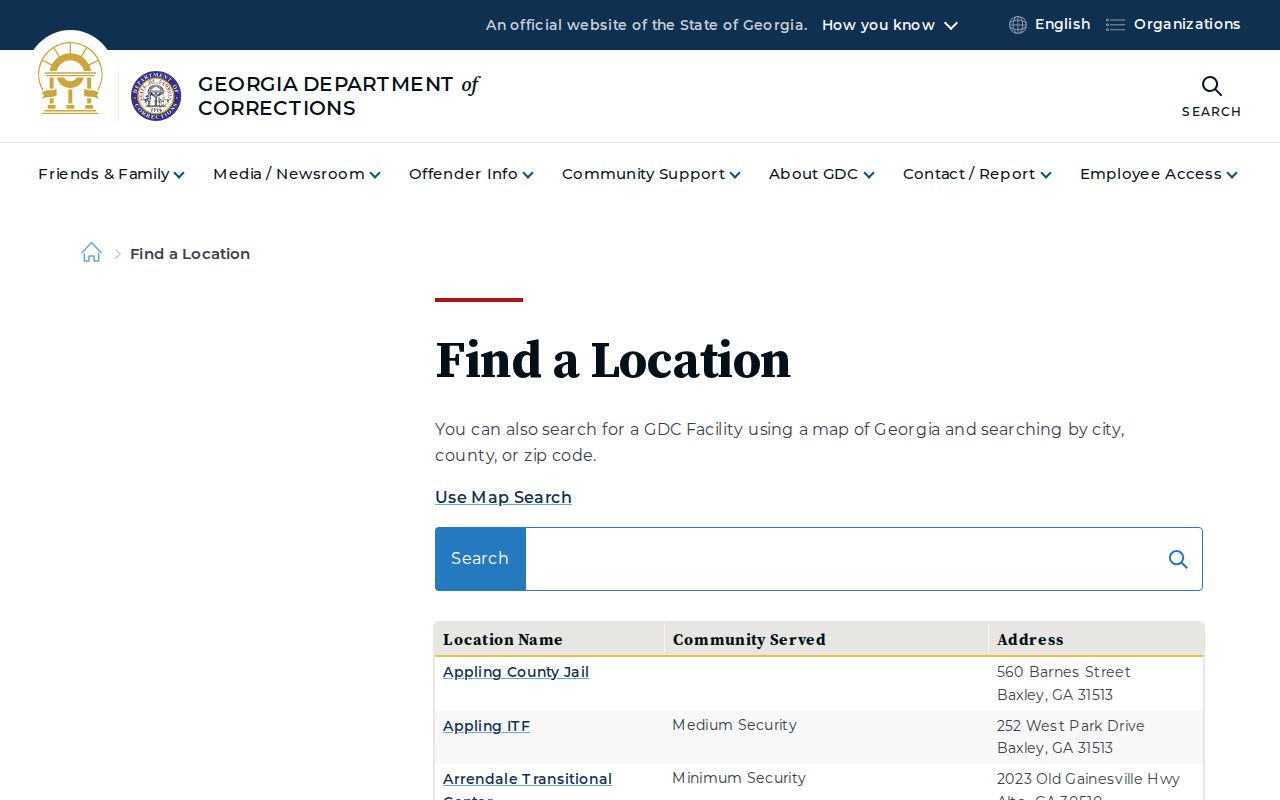
The directory helps locate the institution, while Find an Offender supplies the person-specific status and release fields.
GDC's agency information distinguishes its state corrections role from county jail operations. A county record saying “DOC,” “state sentence,” or “prison transfer” is the cue to change systems. Continuing to refresh the Toombs current-inmate roster after commitment will not show the later state release.
GDC Release Date Fields
The detail record uses several dates that answer different questions. Maximum possible release date is the outer state-prison date from sentence computation. Actual release date confirms a completed release when it displays a date rather than “currently serving.” Current status shows whether the record remains active. Incarceration history and most recent institution help connect the date to the right custody term.
The Board's Tentative Parole Month is separate. A TPM is the month in which final review is expected and a parole date may be set. It is not a final decision. The Board can advance, postpone, cancel, condition, or withdraw release based on the case, conduct, programming, residence-plan review, and legal restrictions.
- Discharge
- Completion or termination of the applicable custody status.
- Parole
- Release from prison under Board conditions and community supervision.
- TPM
- A planning month for parole review, not a guaranteed exit date.
- Detainer
- A basis for transfer to another authority instead of community release.
GDC Sentence and Credit Limits
Georgia sentence dates are not a simple fixed percentage. Work incentive credits under Georgia law may apply to eligible felony prison terms other than life, and GDC's Performance Incentive Credit program links eligible credit to programming, work, and good conduct. Credits are reported to the Parole Board and considered in its decisions. Offense type, sentence category, exclusions, Board discretion, and misconduct can all affect timing.
Parole eligibility rules also vary. General statutory timing has exceptions for serious violent felonies, repeat-offender categories, life sentences, and other laws. A residence plan may need verification, and a parole grant may change before its effective date. Use the public dates as current administrative information, then verify material changes with GDC or the Board.
| Change | Possible effect |
|---|---|
| Sentence correction | Recalculated maximum date |
| Credit or program status | Changed length-of-stay consideration |
| Misconduct | Postponed or canceled parole action |
| Detainer | Transfer rather than community release |
| Residence-plan review | Delay or condition before parole |
GDC Parole and Supervision
A GDC release can lead to parole supervision. The State Board of Pardons and Paroles makes parole decisions, while the Georgia Department of Community Supervision handles field supervision. For people living in Toombs County, DCS identifies the Swainsboro field office as the serving office. Its address is 104 South Green Street, Swainsboro, GA 30401, and its phone is 478-289-2409. Published hours are Monday through Friday, 8:00 a.m. to 4:30 p.m.
The parolee search is the post-release status path. It differs from the inmate TPM lookup used before release. Probation also differs from parole: a court orders probation, while the Board grants parole from a prison sentence. DCS may supervise both, but the legal source is not the same. A GDC inactive status alone should not be read as proof that all community duties ended.
Note: Confirm reporting instructions from the release papers or supervising office because public search fields do not state every individual condition.
Public Record Search
Sponsored Results